Pages

Thursday, September 3, 2015

City Palace- Jaipur, Rajasthan

City Palace, Jaipur

Located in the heart of the Pink City Jaipur, the City Palace was where the Maharaja reigned from. This palace also includes the famous 'Chandra Mahal' and 'Mubarak Mahal', and other buildings which form a part of the palace complex. The palace is located towards the northeast side of central Jaipur and has many courtyards and buildings. The palace was built between 1729 and 1732 AD by Sawai Jai Singh II. He ruled in Amer and planned and built the outer walls of the palace and later rulers added to the architecture of this palace. These additions have been known to take place right up to the 20th century. The urban layout of the city of Jaipur was commissioned to Vidyadhar Bhattacharya and Sir Samuel Swinton Jacob. The architectural styles are largely based on a fusion of Rajput, Mughal and European styles. Today, the 'Chandra Mahal' has been turned into a museum which is home to unique handcrafted products, various uniforms of the rulers and many more things pertaining to the royal heritage of the City Palace.

History Of City Palace
Maharaja Sawai Jai Singh II is known to have commissioned work for building the outer wall of the city's complex. He shifted from Amer to Jaipur due to water problems and an increase in population in 1727. He had entrusted the city's architectural design to the chief architect Vidyadhar Bhattacharya. The architect went on to design the City Palace in accordance with the Vaastushastra texts.

Architectural Layout
The City Palace reflects Rajput, Mughal and European architectural styles although the palace was designed to Vaastushastra treatise. Some of the famous gates are the 'Udai Pol', 'Jaleb Chowk', 'Tripolia Gate' and 'Virendra Pol', which also happen to be the various entrances to the palace. These are all richly decorated. The Palace has been designed according to a 'grid style' and houses various structures such as, 'Chandra Mahal', 'Mubarak Mahal', 'Diwan-I-Khas' and the 'Govind Dev Ji Temple. The walls and gates are ornately designed to Mughal style, with various murals, lattice and mirrors adorning them from sides.
India Tourism

Amber Fort- Rajasthan

Amber Fort is located in Amer (a town with an area of 4 square kilometres (1.5 sq mi)), 11 kilometres (6.8 mi) from Jaipur, Rajasthan state, India. It is one of the principal tourist attractions in the Jaipur area, located high on a hill. Anber Fort Was Built By  Raja Man Singh I.Amber Fort is known for its artistic style, blending both Hindu and Rajput elements. With its large ramparts, series of gates and cobbled paths, the fort overlooks the Maota Lake, at its forefront.
The Amber Fort was built by ‘Raja Shri Maan Singh JI Saheb’ (Maan Singh I) (December 21, 1550 – July 6, 1614) in 16th century. Man Singh, one of the first war chiefs or the trusted general of the Emperor Akbar. Akbar included him among the ‘Navaratnas’, or the 9 (nava) gems (ratna) of the royal court. Man Singh began the construction of a fortress-palace of white and red sandstone i.e. Amber Fort in 1592. He was the Kacchwaha (Rajput) of King of Amber, a state later known as Jaipur. Nearby he ordered to set a small temple devoted to ‘Sheela Mata’, his patron goddess.
Entry Fee (In Indian Rupees):
  • Indian : Rs. 25.00  Student : 10
  • Foreigner : Rs. 200.00  Student : 100
Light Shows Timing (Onwords)
  • In English : 7.30 pm
    Entry Fee : Rs. 200.00
  • In Hindi : 8:00 PM
    Entry Fee : Rs. 100.00

Sunday, August 23, 2015

Hauz Khas Complex- Delhi

Hauz Khas in Delhi is an important site that unravels a part of Emperor Ala-ud-din Khilji’s reign from his capital - Siri Fort. This site also holds forth the days of ruin that ravished the grandeur of Khilji’s reign after his death. Hauz-I-Alai is considered to be the only structure of Siri, which has survived the thwarts of ravishing time.
Hauz Khas in Delhi says that this tank was built by Ala-ud-din Khilji in 1300 to ensure continuous supply of water to Siri Fort. Initially, this tank located on the eastern side of Siri, preserved rainwater, which could be later disbursed throughout the year. With gradual passage of time, this tank dried up and Firoz Shah Tughlaq much later mended it. He also constructed various other monuments around the tank. Along with all these monuments, the site of the tank came to be known as Hauz Khas (royal tank).
If you visit this place now, you will be pleased to see that a cosmopolitan town has grown around the site, which has both residential and commercial hubs. I fact, Hauz Khas in Delhi, is now popular as a shopping center because a number of boutiques of famous fashion designers, antique and curio stores have been opened up in this area. Thus after visiting Hauz-I-Alai, you can also visit Hauz Khas Enclave, Kalkaji Temple, Lotus Temple, Nizamuddin's Shrine and Chirag Dehlvi's Dargah.


Firoz Shah Tughlaq’s tomb forms the centre of the complex, though. A liberal ruler, he is credited with a voluminous amount of architectural development during his 4-decade rule. The centre hall housing the dome is based on squinches to support the structure. Local quartzite was used for the floors & walls, giving a plaster finish for the shine. Hauz Khas is Delhi has a prominent location. It is located on Aurobindo Marg just a little beyond Aurobindo Palace.


Nizamuddin Dargah-Delhi

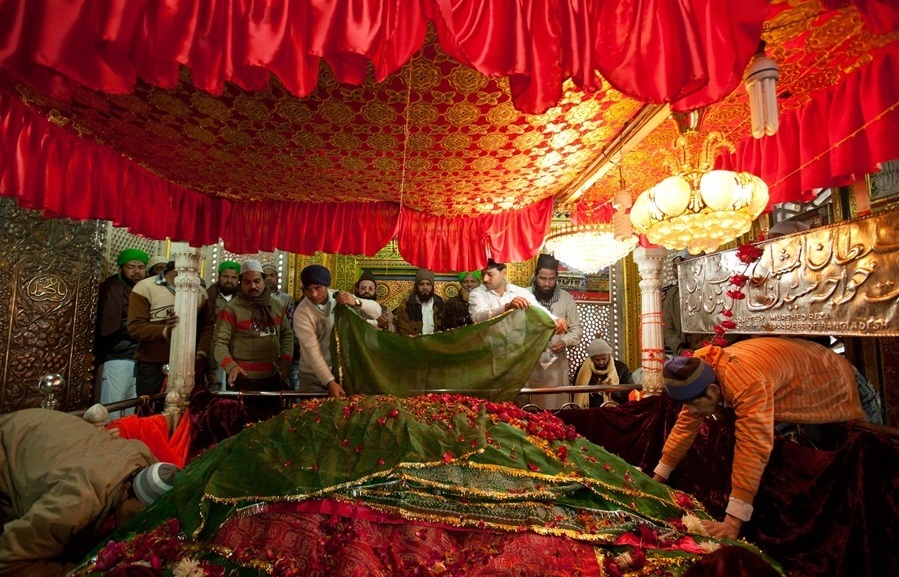
Nizamuddin Dargah is the holy shrine of Hazrat Nizamuddin Auliya  who is counted among the world’s most renowned Sufi saints.It is located in the Nizamuddin West area of Delhi. 
This dargah is  among the popular attractions of Delhi. It is visited by thousands of Muslims, Hindus, Christians and people from other religions daily.The tombs of poet Amir Khusro and Mughal princess Jehan Ara Begum are also located within the Nizamuddin Dargah complex, and Inayat Khan's tomb is just around the corner.Thousands of people belonging to different religions, ethnicities and culture flock every day to seek blessings and offer homage at the ancient shrine of Nizamuddin Aulia.


The other important monuments in the Nizamuddin heritage area includes the Jama’at- Khana Masjid, Chini Ka Burj, Mirza Ghalib’s Tomb, Kalan-Masjid, Khan-I-Jahan Tilangani’s Tomb, Ataga Khan’s Tomb, Chaunsath Khamba, Lal-Mahal, Khan-I-Khanan’s Tomb and Barapula.The structure consists of a square chamber surrounded by verandahs, which are pierced by arched openings.Hazrat Nizamuddin's tomb has lattice screens called jalis, marble arches and courtyards. Devotees tie red threads to screens.Devotees offer prayers, shower rose petals and light incense sticks before the shrines.The dargah can be visited any day but every Thursday, special Qawwali programmes are organised here and it is adorned with beautiful lights.Many Islamic festivals are celebrated here including Urs and the death anniversary of the Sufi saint, Nizamuddin Auliya and Amir Khusro .Syed Muhammad Nizamuddin Auliya was a Sufi saint of the Chisti order in the Indian subcontinent. He stressed love as a means of realising God. For him love of God, implied love of humanity.


Saturday, August 22, 2015

Agrasen ki Baoli -Delhi

Designated as protected monument by Archeological Survey of India, Agrasen ki Baoli in Connaught Place is a 60 meter long and 15 meter wide historical step well on Hailey Road near Connaught Place. To get it there you have can reach Jantar Mantar (at Connaught Place) and from there it’s short walk from there towards Kasturba Gandhi Marg. Agrasen ki Baoli is a 14th Century Structure nested between the multi-storey buildings in Connaught Place. It is believed that this Baoli was originally built by the legendary king Agrasen during the Mahabharat epic era. Baoli is a Hindi word and it means a step well. Agrasen ki Baoli is being made to provide constant water supply to the city and a resting place for the travellers. 
Agrasen ki Baoli is also a water reservoir that is known for its heritage value. The shape of Agrasen ki baoli is very interesting. The reason for this is its unique structure which is quite different from the traditional round shape. The Agar Sain ki baoli has three levels where each level has an arched area, which was used as a resting place. The center of the well has water and the water is also linked to a well dug in a covered platform. The gallery and chambers surrounded walls of Agarsen ki baoli are carved profusely. These chambers used to become cool, quiet retreats during summers. Such structures definitely are among the many things that tourists would like to admire if for nothing but the novelty of the concept. The visiting hours for the Agarsen ki Baoli is between 9 AM and 5 PM.

Humayun's tomb-Delhi

Humayun’s Tomb is one of the most beautiful monuments in Delhi but you don’t see it as often as you see India gate or Qutub Minar. It is located right in the heart of the city but the spacious compound surrounding the monument hid it away from the glare of public eyes. Sandwiched between Yamuna River and Nizamuddin Dargah, Humayun’s Tomb was the first garden tomb on the Indian Subcontinent. It is the Tomb of Mughal Emperor Humayun and it was commissioned by his wife Hamida Banu Begum in 1562 AD.

I've no difficulty admitting that it is one of the most beautiful Tombs, only next to Taj Mahal. Designed by Mirak Mirza Ghiyath a Persian architect and built by Indian and Persian workers, this monument is one of the first to employ Persian architecture and also the first to use Red sand stone and White marble in such a huge quantity. In 1993 it was declared a UNESCO World heritage Site.
The garden tomb is some hundredmeters walk from the main road. The place is quite spacious and refreshing. The place is undergoing lots of renovations right from the outer gate to the main tomb. An outer gate and an inner gate surround the main tomb. Near the outer gate which is also known as the Bu Halima, there’s another gate known as the Arab Serai Gate. It is a 14 m high structure which led to the walled enclosure which hosted the Persian Craftsmen who came to work on Humayun’s Tomb. The main entrance or the inner Gate is also known as West Gate. It is a 16 m high structure with rooms on each side of the passage. Now it housed the museum.
This red and white building is an example of Persian influence on Indian architecture. Humayun was the first to be buried in the Tomb when he died in 1556 but the tomb has now within it over 100 graves, earning the name, ‘Dormitory of The Mughals’. Steep steps lead up to the Sanctum of the tomb. The Central chamber looks quite plain now but it was remarkably decorated in the past. William Finch an English Merchant who visited it in 1611 unforgettably describes the presence of expensive carpets, and other rich items including Humayun’s sword, turban and shoes.
The 13 acres land surrounding the tomb became difficult to maintain when the Mughals shifted the capital to Agra. Things got worsened when the British captured Bahadur Shah II in 1857. They replaced the original garden with British like garden. Archaeological Survey of India has tried to restore it to the glorious past. The vast open spaces and cool shades surrounding the tomb are a treat for city dwellers.
Though the monument we see now is only a shadow of the glorious past, the red Sandstone tomb sparks when the golden evening sun shines over it. The magic of that moment makes everything new again.

Gurudwara Bangla Sahib-Delhi

An ideal consummation of Sikh values bequeathing the human race with a beacon of hope for a better future, Gurudwara Bangla Sahib located in New Delhi is one of the most prominent Sikh Gurdwara. Gurudwara Bangla Sahib holds a special meaning in the heart of thousands of devotes who visit the premises with a belief to get closer to a complacent lifestyle.

Originally a bungalow of Raja Jai Singh, an Indian ruler, Gurudwara Bangla Sahib came into existence in 1783 as a symbol of benignant of Guru Har Krishan Sahib Ji, eighth guru of Sikhs, who served the downtrodden during the epidemic of 1664.
Gurudwara Bangla Sahib is situated in the Delhi City. Built in the sacred visit of SHRI GURU HARKARISHAN JI to Delhi. At the request of Mughal King Aurangzeb and through the persuasion of Mirza Raja Jai Singh of Amber, GURU SAHIB agreed to come to Delhi. Raja Jai Singh invited GURU SAHIB to the present site which originally belonged to Raja Jai Singh. Raja's wife thought of testing the spiritual powers of the GURU SAHIB and disguised herself as maid servant and sat among the attendants. GURU SAHIB at the age of 8 years identified the RANI and sat in her lap. Thus convincing her of the the spiritual powers of GURU NANAK and his True Disciples. In those days small pox was raging in the city of Delhi on an epidemic form. The citizens of Delhi suffered grief and death As a result of clamity that had befallen there. GURU SAHIB out of love and compassion for suffering humanity dipped his holy feet in water and poured charan amrit into small chaubacha (tank). All those who took water from caubacha were cured from the disease. Thus the people of Delhi were saved from that epidemic. Devotees with faith and devotion come from far and near and get rid of suffering by taking a dip in the holy water.